
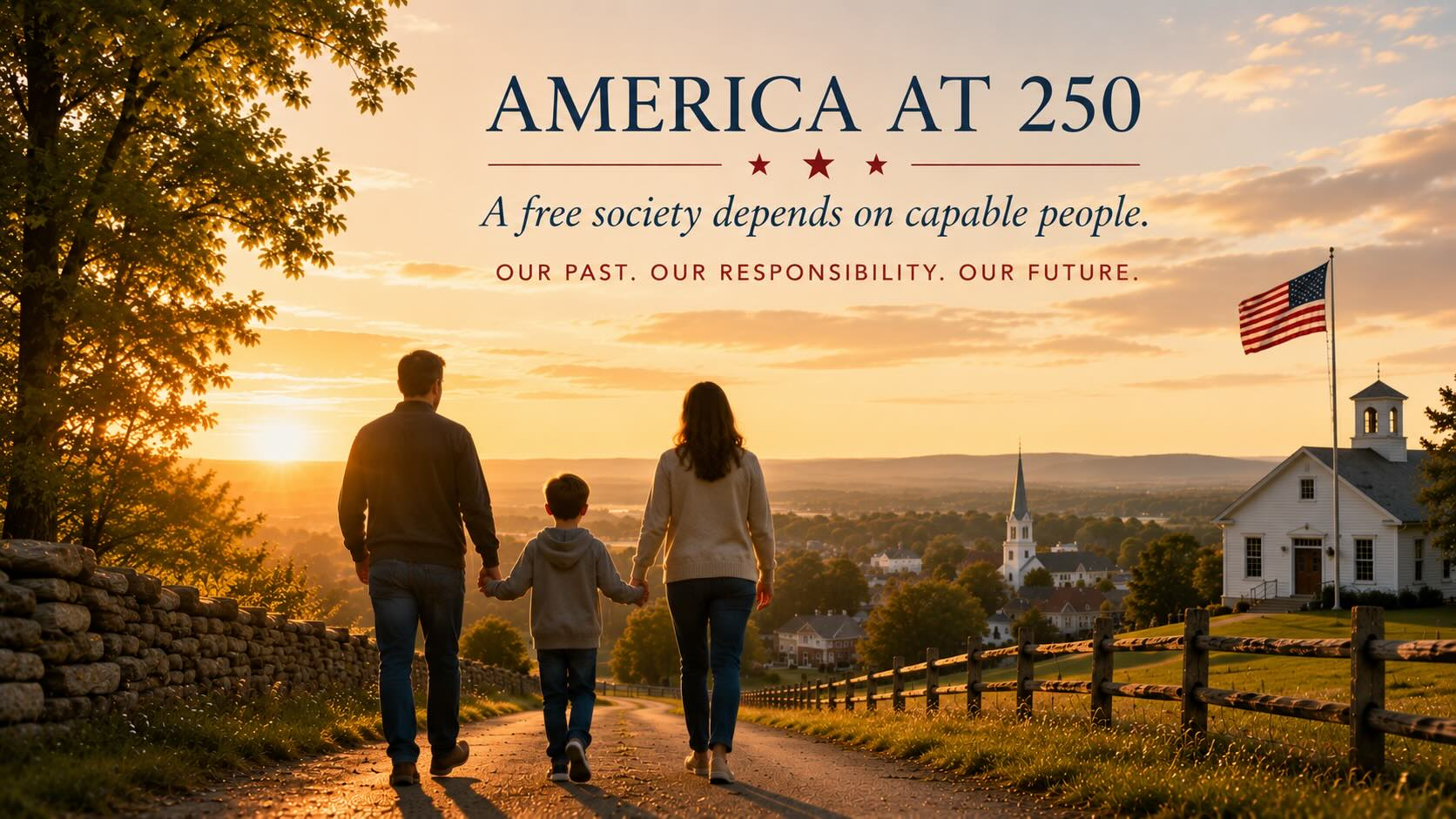
How do we help people become more capable so they can better steward the freedoms and responsibilities they’ve inherited?
To mark the 250th anniversary of America’s Declaration of Independence, we’re asking a forward-looking question that reaches beyond politics or technology: What most helps a freely independent society remain free? This reflection is our contribution to that conversation. We hope it encourages thoughtful discussion as we look toward strengthening independence for generations to come.
250 years ago, our founders first boldly risked their lives at tremendous cost to secure independence from the greatest military power on Earth at the time, Great Britan. Then, only four short years after winning freedom and drafting a first of its kind constitution – in just 4 months – they entrusted both that Constitution and the nation it would shape to the people with a precarious understanding that both would always remain works in progress and could only survive in the hands of a capable and responsible citizenry.
Today, as America celebrates 250 years since it had the courage to declare independence, yes, our challenges are different, but the underlying question remains unchanged; Can a free people continue to govern themselves responsibly?
We believe they can.
But only if they remain capable—a truth our Founders recognized from the beginning—which might be the defining challenge of our time as we have increasingly traded trust in our capabilities for trust in systems:
Technology.
Institutions.
Algorithms.
Organizations.
Government.
Corporations.
Sure, each has an important role to play, but none of them can replace the judgment, character, and responsibility needed to develop capable citizens.
The question now: What tools do we have to turn that around and help strengthen capable people?
Every generation develops new tools intended to improve quality of life.
The question is never whether tools change.
The question is instead whether people can use those tools to become more capable both as individuals and as a collective community.
When tools strengthen human capability, they strengthen independence.
When they diminish it, they weaken the very foundation upon which free societies exist.
The future will undoubtedly bring technologies more powerful than any we can imagine today.
Those technologies are neither something to fear nor celebrate without clear-headed, balanced assessment.
They are instead, and most importantly, something to steward wisely, which leads to a straight-forward question:
If, as our forefathers correctly believed, a free society depends upon capable people, what capabilities are we helping people develop through the wise use of new tools?
The answer is actually nothing new to mankind – but still vitally important – and it begins with developing people capable of:
Thinking critically.
Learning continuously.
Caring for themselves and their families.
Contributing positively to their communities.
Accepting responsibility.
Helping others grow.
And using new tools with wisdom rather than dependence for a common good.
If new tools, combined with human imagination, help people become more capable, confidence naturally follows.
When confidence grows, trust grows.
When trust grows, communities become stronger.
That is how independence endures.
The future belongs not to those with the newest technology.
It belongs to those who use new technology to help people become more capable, more confident, and more committed to the common good, which is the foundation of responsibly committed independence.
Perhaps that is one way we can honor the remarkable trust our Founders placed in the American citizen 250 years ago.
Not simply by celebrating the past.
But by becoming worthy stewards of the future they entrusted to the people—for our generation and for every generation to follow.